
After the passing of our British-born grandmother, Gladys Fox (née Hope), in June 2021, my brother Lance and I became intrigued by the story of her wartime RCAF fiancé, F/O Wendell “Del” Pierce Drew of RCAF (RAF) 405 Pathfinders Squadron, who went missing with his entire Lancaster III JB707 crew somewhere over the North Sea on 29 July 1944.
We soon learned that the remains of a single member of that ill-fated crew had in fact been discovered several months after their plane failed to return to England from a bombing raid to Hamburg: the body of air gunner P/O Colin John Blyth of Winnipeg, Manitoba, was “recovered” by the Germans on the beach of Bjerregård, Denmark, on 8 October 1944 (according to the German record in his service file) and buried in the sand dunes under a wooden cross upon which, according to another source, was inscribed “Colin John. CAN-R 100467 beigesetzt* am 7.10.44.” (So the exact date is unclear.)
Beach warden Per Christian Dahl, after discussing the matter with the vicar Huus and postman Aage Ottosen, tried to arrange a meeting with the local German commander regarding proper burial; the commander refused, referring Dahl to a late-summer German order that all enemy Terrorflieger be “buried on the spot.”
After the liberation of Denmark, on 28 June 1945 the graves of Blyth and two others were reported to the police in Ringkøbing, who were led to their locations by a nine-year-old Danish boy named Otto Christian Ottosen.
It was, then, the Danes who gave Blyth and the two other allied airmen who had washed up on the shore—Sgt. F. W. Webster of RAF 138 Squadron and Sgt. Arthur Robson of RAF 582 Squadron—a proper resting place on 1 July 1945 in a small churchyard just a few kilometres further up the coast in Haurvig.
I had hoped to go home to Canada for a visit this summer—it’s been five years since my last trip—but sky-high airfares, strikes, and airport chaos on both sides of the Atlantic nixed that idea. So, my husband and I decided to instead take a trip on the ferry from Larvik, Norway, to Hirtshals, Denmark, where we spent a week in Jutland and got to visit Blyth’s grave on 7 July 2022.
Using the incredibly charming bed and breakfast Pension Lærkelill (I cannot recommend this place enough) as our base, from which the western coast of Jutland is a short and scenic drive, we made our way to the beach in Bjerregård. Around seventeen degrees Celsius, it was a very windy day that had started out very overcast. But at around three o’clock, just as we approached the southernmost edge of Ringkøbing fjord and started up the narrow strip of land that separates the fjord from the sea, the sun broke through the clouds, revealing a blue sky.
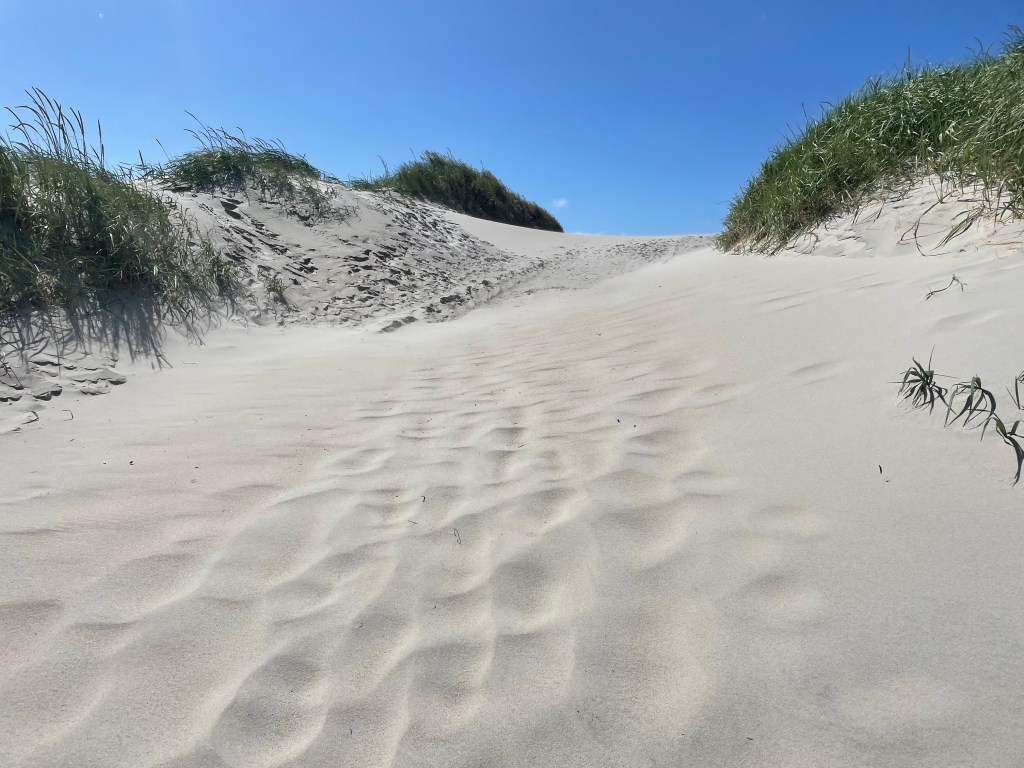
Arriving in Bjerregård, we turned left onto Bilbergsvej and followed it right to the end into a parking lot beside the sand dunes one must ascend to have any possible view of the sea. Since it was a windy day, I expected the water to be choppy. But I was quite taken aback by what I saw from the top of the dune: large, rolling, rugged waves that glistened a blinding bright white as they crashed onto the shore. It was a magnificent place but also an inhospitable one; the deafening ferocity of the waves and the wind made for a dramatic scene magnified by a rather large object I would encounter some distance away in the sand.

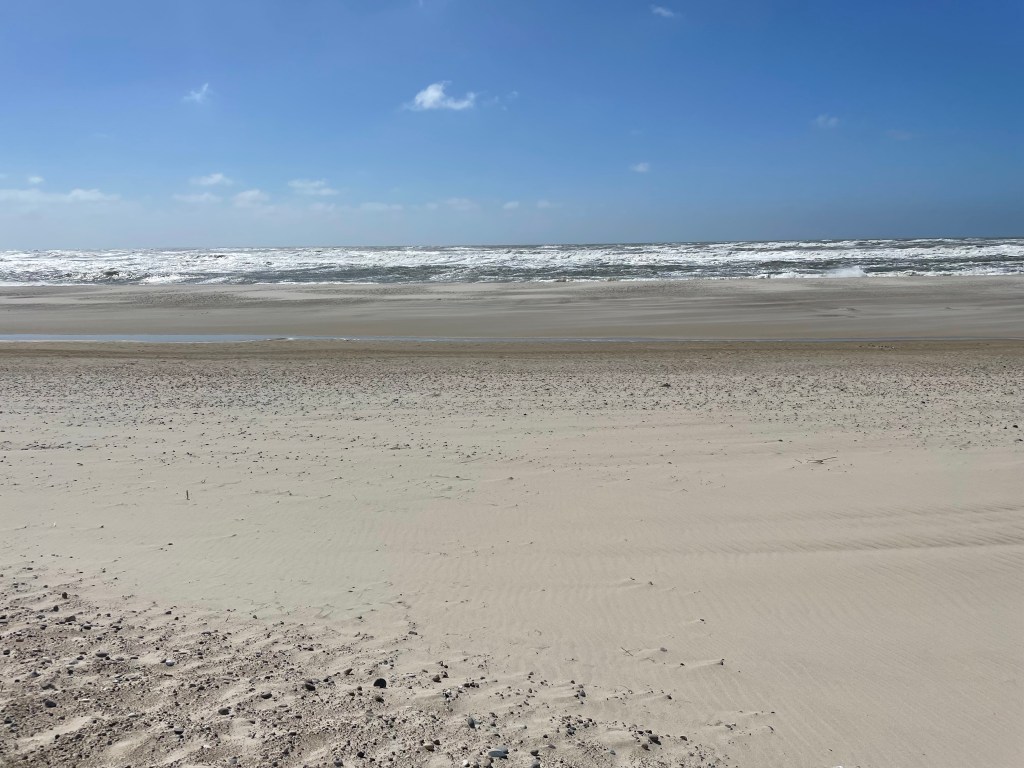

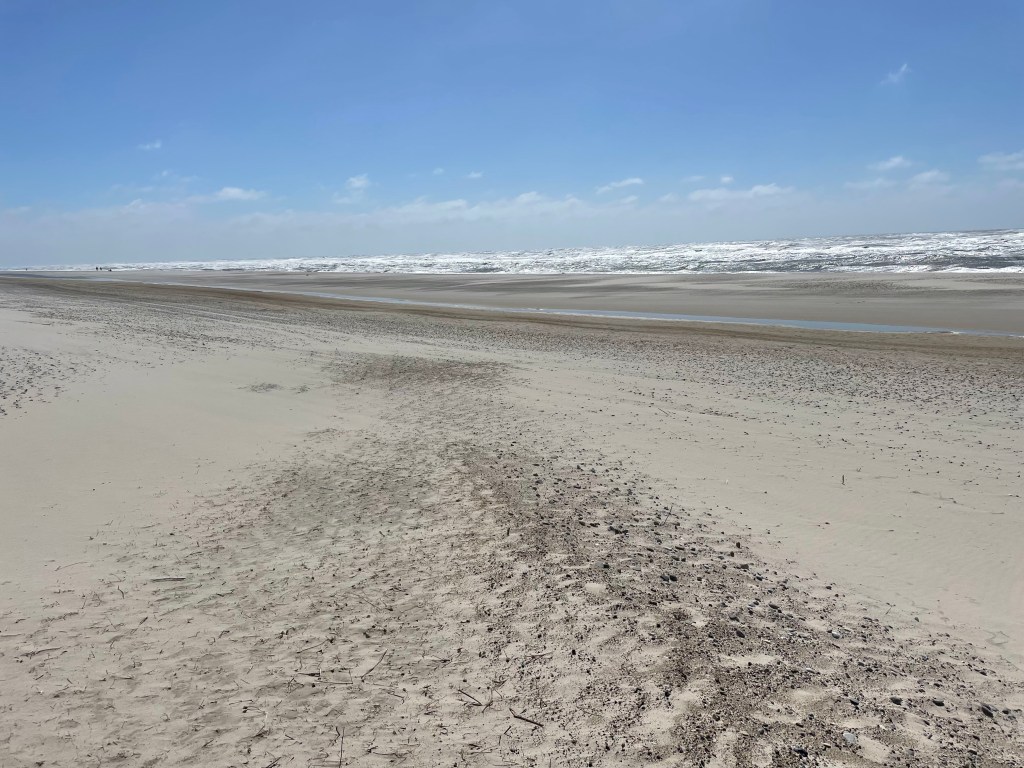
According to AirmenDK, a Danish site that has compiled the details of allied planes and airmen shot down over Denmark or Danish waters during WWII, Blyth’s body had washed ashore slightly north of the beach entrance from Bilbergsvej. Somewhat eerily, on the approximate spot where he was found was a fairly large carcass (as pictured at top) of what appeared to be a type of dolphin (perhaps a harbour porpoise common to this part of the North Sea).
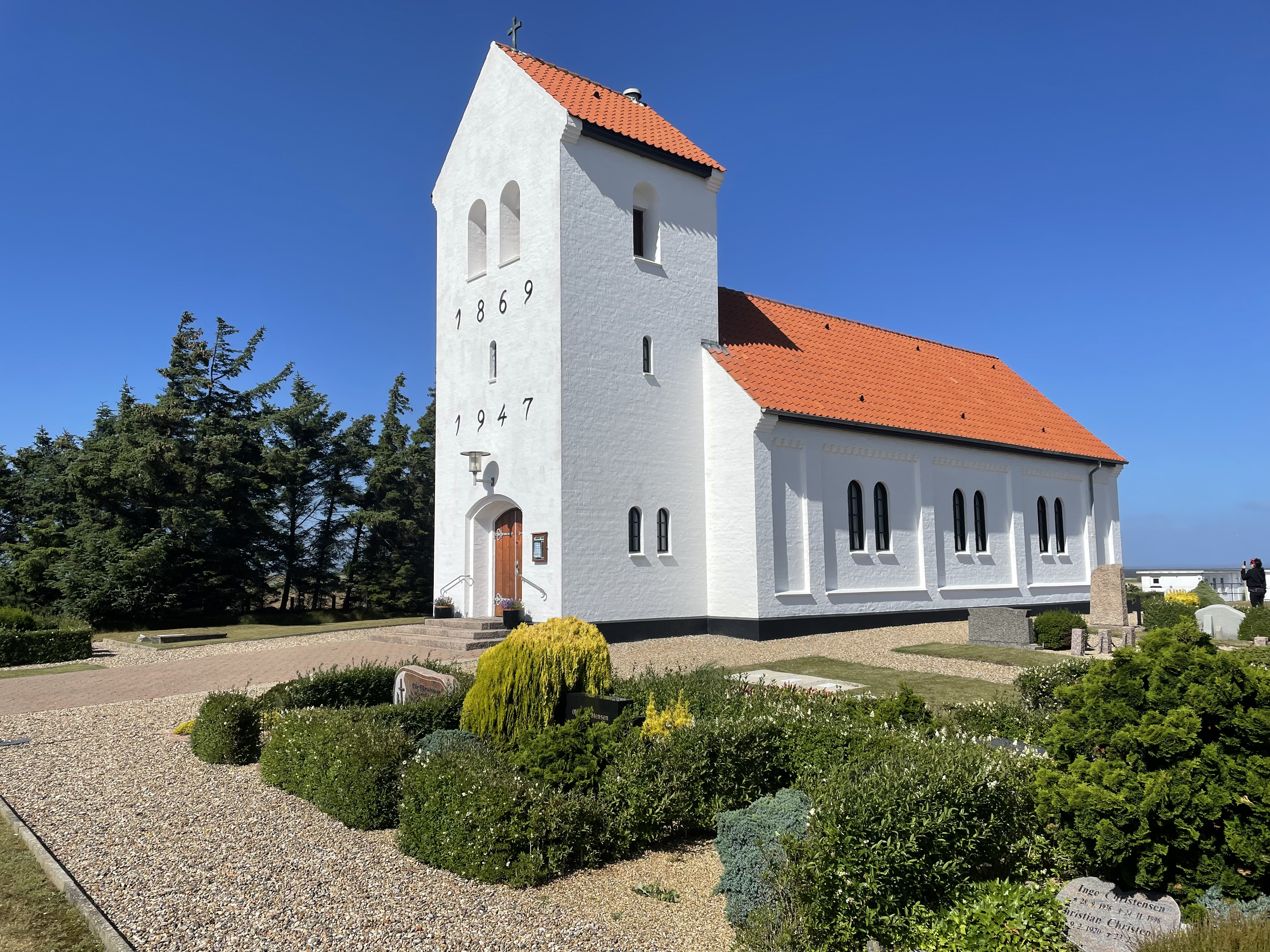


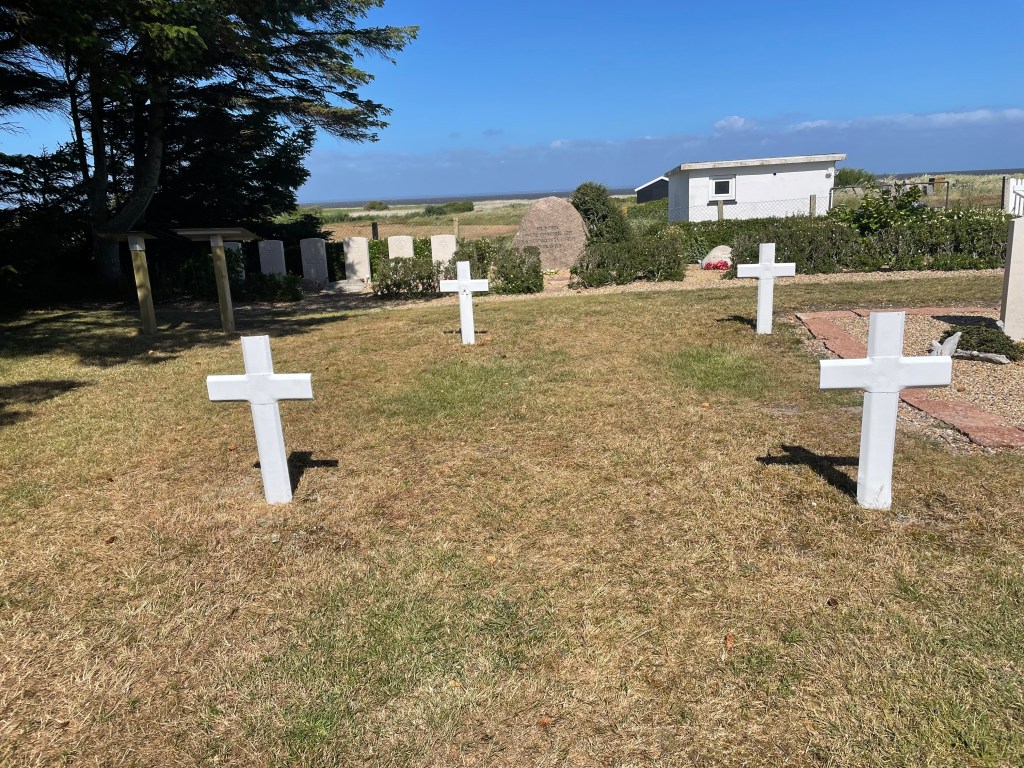
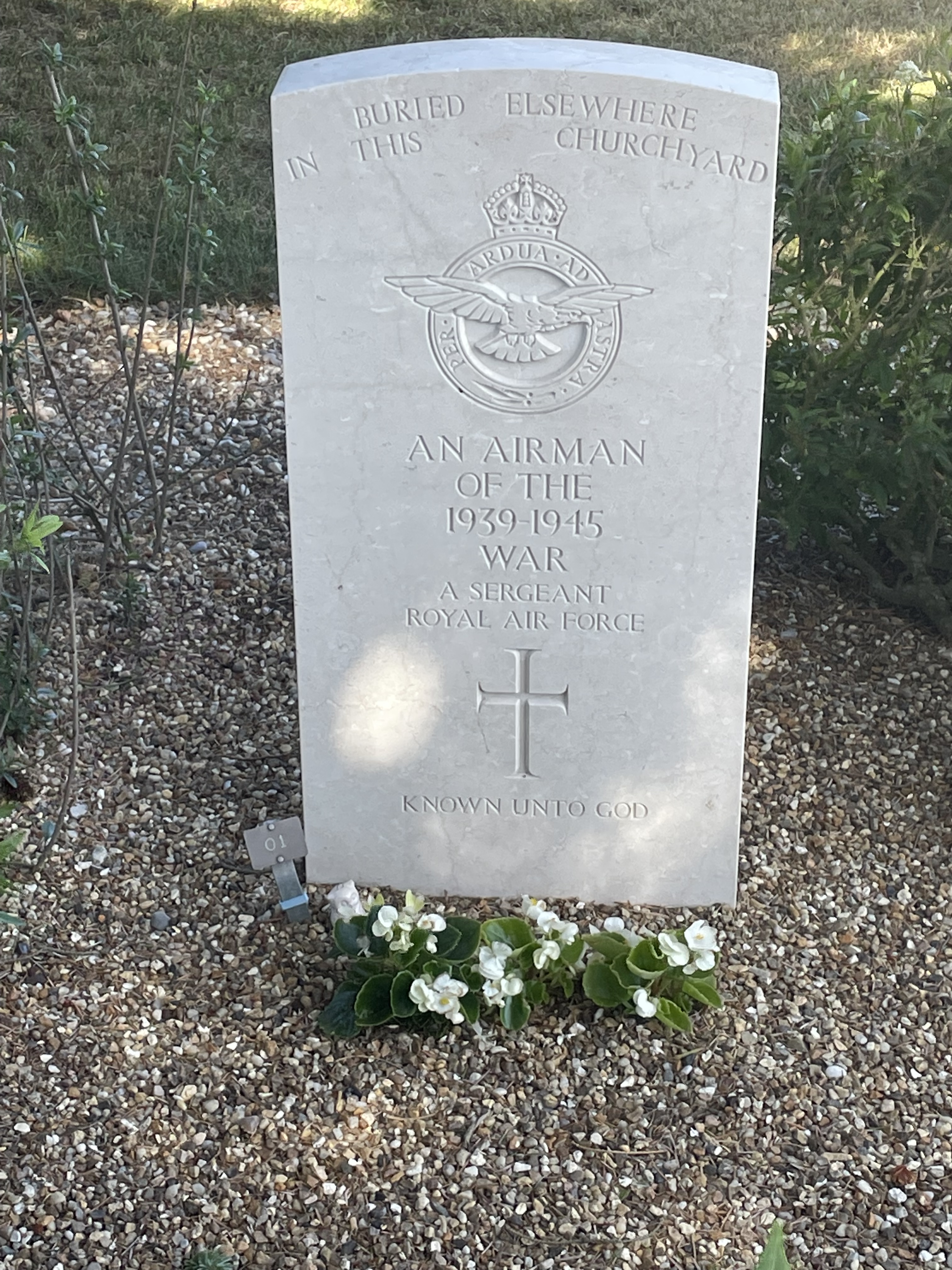
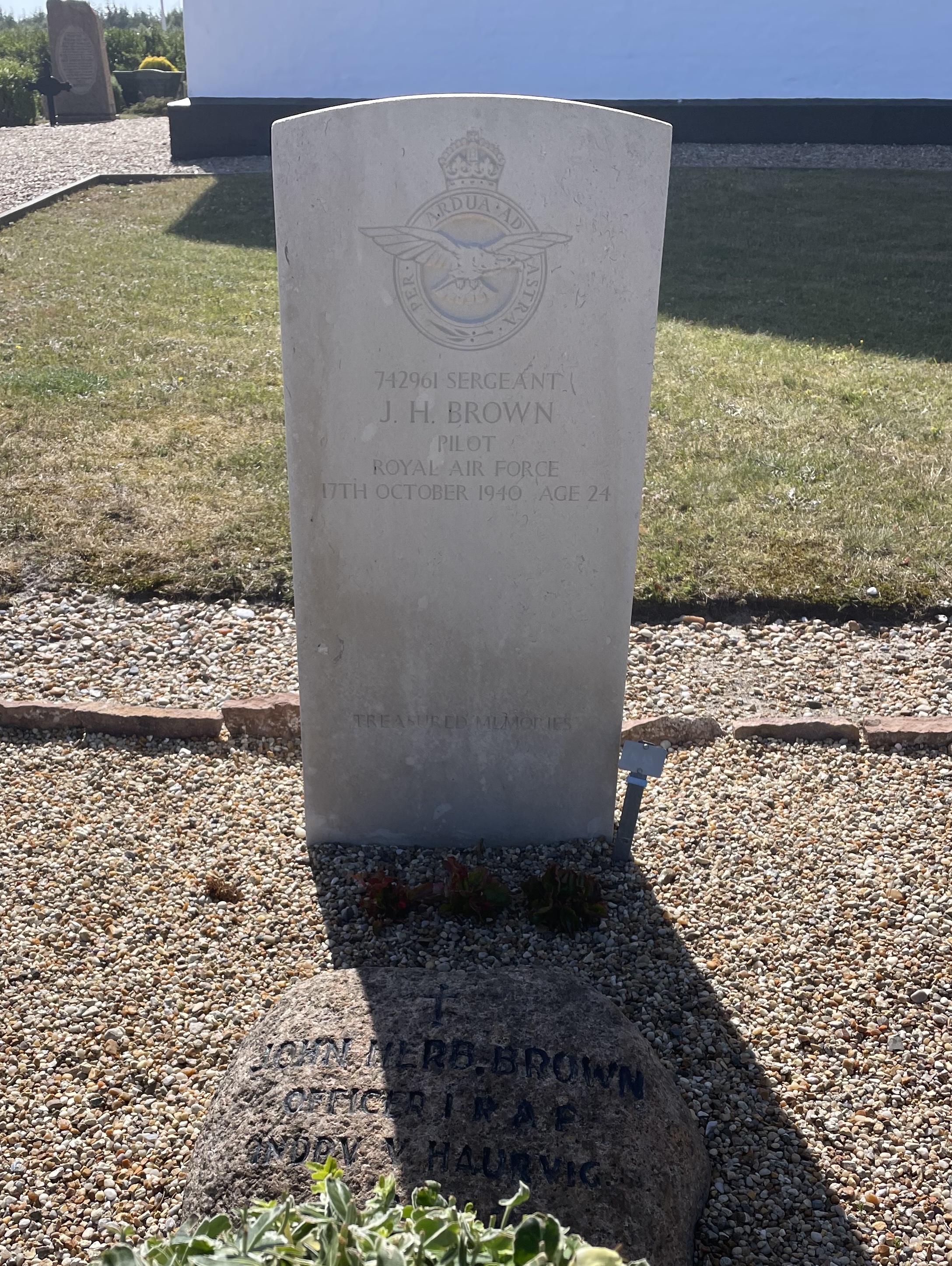
The beach not being a place we could linger long under such windy conditions, we walked back to the car and continued our journey a few kilometres north on the main road to Haurvig churchyard, a Commonwealth War Graves cemetery, where Blyth and several other allied airmen are now buried. They are as follows:
- Sgt. Arthur Robson (RAF 582 Squ.)
- Sgt. Francis William Webster (RAF 138 Squ.)
- Sgt. Allen John D. Ingram (RAF 50 Squ.)
- Sgt. John Herbert Brown (RAF 144 Squ.)
- An unknown Sgt. RAF airman
Also buried here are:
- Walter Scott (Leading Motor Mechanic, Royal Navy)
- Albert E. Barclay (American, Maritime Regiment, Royal Artillery)
- Four unknown allied soldiers (buried under white iron crosses)

According to a placard in the cemetery, there was great participation by local Danish citizens and the resistance movement for the burials of Blyth, Robson, and Webster on 1 July 1945.
All the graves are in absolutely pristine condition, as are the cemetery grounds. Fresh flowers were planted in front of each headstone. One feels the deep respect and gratitude of the Danish people expressed in the beauty of Haurvig churchyard and in the care they have shown the graves of these men to this day.
Twenty-five years old when he died, Pilot Officer Air Gunner Colin John Blyth was the son of Frederick and Emily Blyth of Winnipeg, Manitoba. On his gravestone is the following epitaph:
AS WE LOVED HIM
SO WE MISS HIM
DAD AND MUM


My brother and I have been amazed by the connections we’ve made with others and what we’ve learned from them through my post last year about Del. And, because these airmen had such a bond with their crewmates, even unto death, all the members of Del’s crew are of interest to us.
In addition to Blyth, the crew of JB707 who perished on 29 July 1944 were as follows:
- Pilot Flying Officer Elwood Albert Townsend (age 22, son of William H. and Ida May Townsend, of Toronto, Ontario)
- Flight Engineer Sgt. Derek Charles Carrott (age 18, son of Samuel Charles Frederick and Jessie Fraser Carrott, of North Finchley, Middlesex, England)
- Navigator Flying Officer William Clifford Morrow (age 27, son of William Gordon and Susan Sophia Morrow, of Peterborough, Ontario; husband of Lilian Morrow)
- Air Bomber Flying Officer Elwood Cameron Pomeroy (age 20, son of Cecil Benjamin and Hazel Alice Pomeroy (née Strout), of Prescott, Ontario)
- Air Gunner Wing Commander Charles Gray (age 36, son of Frank and Iris Irene Gray, of Vancouver, British Columbia)
- Wireless Operator Flight Officer Wendell Pierce Drew (age 23, son of Albert George and Achsah Anna Drew (née Swail), of Radisson, Saskatchewan)
Except for Carrott, who was British (we have been able to connect with a family member of his), all the crew members were Canadian.
To pay my respects, and out of thanks for his sacrifice, I left a Canadian flag and a card at Blyth’s grave. I think my grandmother would have appreciated it. And perhaps someone out there with connections to Colin Blyth—or any of the others—will find us someday. As we have discovered this past year with the connections we’ve made from sharing Del’s story, you just never know who is out there keeping the memory of these fallen heroes alive.
UPDATE January, 2025:
We recently heard from a reader of Following the Echoes in Denmark, Alan Hobbs, who was able to tell us more about beach warden Per Christian Dahl, mentioned on page 79.
Dahl, who was Strandfoghed (wreckmaster) at Bjerregård (where Colin Blyth’s remains washed ashore in October 1944), published two volumes (in 1973 and 1974) of Strandinger og Strandingsgods, Livet på Gml. Bjerregård (Wrecks and Wreckage, Life at Gammel Bjerregård), for the time periods of 1796–1923 and 1923–1963.
Alan was able to share the following quotes (translated from Danish) pertaining to Colin Blyth’s grave. (The opening remark in the first passage refers to the Germans disbanding the Danish police force on September 19, 1944, and assuming police functions themselves under martial law.)
I gradually realised how disastrous it was for us to have lost the Danish police. From a man who drove for the Germans we learned that they had buried an English airman in the dunes outside the northern part of the town, which horrified us. Postal contractor Aage Ottosen, who was also a Strandfoghed, had discussed this with Pastor Huus, who was also dismayed. It was decided that I should take it up with Guard Commander Bolvig and explain that Pastor Huus, Aage Ottosen, and I would like to talk to him about the stranded body. I cycled to the Guard Commander and told him what we wished, but it was totally rejected. Bolvig showed me a document from the German Command which said that ‘enemy terror-fliers’ should henceforth be buried in the dunes. I explained the local population’s horror at this disrespectful treatment of the dead, but that failed to move him at all. “The subject is closed” he said.
Strandinger og Strandingsgods, Volume 2, page 76
Police sergeants Kjeld Hansen and Andersen from Ringkøbing arrived to help us retrieve the body, which, in the autumn, the Germans had refused to allow me to take away. A cross was on the grave but the police said that I wasn’t very good at reading German as I had reported that it was the airman’s name but it actually read ‘Here lies an enemy terror-flier’. We dug the body up, but the police had a hard job trying to identify him, as the Germans had removed all identification documents. They eventually found a small numbered disc, which the Germans had either missed or left behind. I drove the body away. When the police had eaten with us at midday, we searched for the body which was buried west of the farm. Dahl Jensen and Godtfred Rauhe helped us. Dahl Jensen’s directions were exact, as up in the dunes at a depth of three alen, we immediately found the body of an allied airman. Identification papers lay on his chest. The police later went to the northern part of the town where the very first body had been buried. There was a cross with the man’s name on the grave. With the help of the Strandfoghed, this body was also dug up and the police asked me to purchase three coffins in Nørre Nebel.
Ibid, page 94
(Note: An alen is an old Danish measurement, 62.7 cm in modern terms. One of the three bodies mentioned must have been that of Colin Blyth.)
The residents of Haurvig parish laid a beautiful memorial over the seven allied graves in Haurvig churchyard. At Gammel Bjerregård we found seven lovely natural stones from beneath the farm’s north wing. Stonemason Christiansen engraved the necessary inscriptions of each man’s name, rank, the date when he was found, and the date of his final burial. On the centre stone was also engraved ‘These stones were raised in thanks to our allied friends for our liberation.’ After high mass on a midsummer Sunday, the stones were put in place and Pastor Huus expressed our thanks in the most beautiful way. The congregation, members of the Resistance forces, and many others were there in large numbers, and the memorial service ended with the seven graves covered with flowers and wreaths with ribbons in allied colours from the Resistance.
Ibid, page 96
Also in Volume 1, Dahl mentions the gravestones:
“When Chr. Larsen Vestergård from Ulfborg, editor Chr. Nielsen, my father, and I sat outside on the stone one summer evening many years ago, chatting, Chr. Larsen Vestergård suddenly jumped up as if stung by a bee and looked gravely at the stone he had been sitting on. ‘It’s strange,’ he exclaimed, ‘It’s a chancel arch stone I’ve been sitting on.’ This is likely correct, and it probably originates from the chancel arch of Nysogn Church. Whether it was out of reverence for the stone that the assessor placed it there, I don’t know. When, after the liberation, we placed memorial stones on the graves of the seven Allied soldiers at Haurvig Cemetery, we chose seven beautiful natural stones that had been used as foundation stones under the northern wing of the old Bjerregård, which was rebuilt in the 1930s.”
It is clear from this information that the Danes did not simply select any old stones to mark the graves of the allied airmen who washed ashore. As is still evident to this day through the special care these graves receive, the Danish people have not forgotten the sacrifice of Colin Blyth and the others resting a Haurvig.
Many thanks to Alan Hobbs for sharing this information with us.

*Note: Original source appears to contain a typo. Edited for accuracy: beigesetzt means buried in German.

 Claudia Fox Reppen
I’m so glad you shared this. Tears for those who have taken the time to show respect for those known and unknown who gave up life for so many of us.
LikeLike