Following the Echoes: Into the Abyss

See also:

In the latest installment of Following the Echoes, it’s been quite a week of developments related to some of the individuals featured in my earlier post “The Others.” There will be more to follow, but this post is dedicated to the crew members of Wellington HX726, of which Wendell “Del” Drew was the sole survivor when their plane crashed at Luqa, Malta, on February 13, 1943.

Recently, my brother and co-author, Lance Fox, and I were able to connect with Cate Wagstaffe. Just like Del Drew, Cate’s British great-uncle, Warrant Officer John Michael Wagstaffe, served with 458 RAAF Squadron on Malta. And, like Del, he was involved in a crash there. Unlike Del, however, Wagstaffe did not survive: he and four of his crewmates were killed on April 19, 1944.

Cate, who is a Canadian flight correspondent for the 458 RAAF Squadron Association, came across our book, Following the Echoes, while researching the HX726 crew for the squadron’s newsletter, including Harold Ernest Stanley (p. 28), Lawrence Harry Gleason and Maurice McAllister Kempton (p. 14), and Peter Edwyn Brown (p. 26). She has been instrumental in helping us research these latest details and photos.

This past October, Cate and her family were able to make a very special trip to Malta (featured here on CBC: Del’s crewmates appear starting at 2:08; at 4:24 their gravesite is shown) to visit her great-uncle’s grave for the first time and, as Canadian flight correspondents for 458 Squadron, to represent all the Canadian members who died in Malta. There they visited the Aviation Museum and were welcomed by its owner, Ray Polidano, who showed them a chapel that houses a book listing all the names of lost 458 Squadron members.

In Following the Echoes, we shared:

Four days after the crash, on February 17, Del’s crewmates were all buried with full military honours at the Malta Capuccini Naval Cemetery just outside the village of Kalkara, an event that we cannot be certain, but expect, he attended (p. 60).

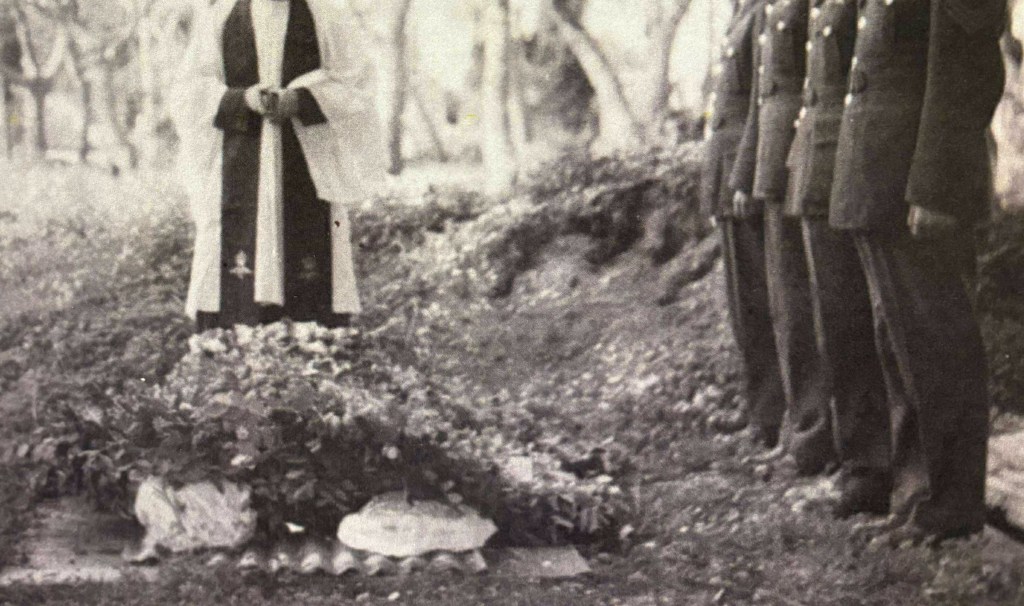
Thanks to Cate’s trip to Malta and this haunting photo we received from Rhys Nye, the nephew of Del’s crewmate Harry Gleason (who perished in the crash), we now have proof that Del indeed attended the funeral:

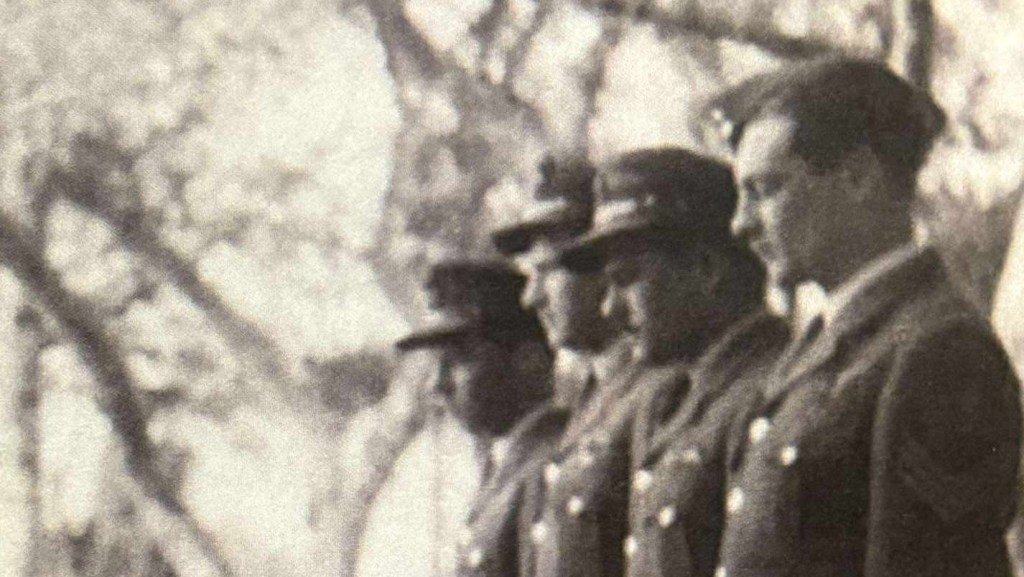
Funeral for the crew of HX726, 3:00 pm, February 17, 1943, Bighi Cemetery, Malta. Wendell Drew is at front right. Leonard Laforet is on the opposite side, second from the front on the left. Photo: Courtesy of Rhys Nye.

Close-up view of sole survivor Wendell Drew, staring into what must have felt like the abyss, as he buries all his crewmates. Wendell would not escape the abyss either, perishing over the North Sea in July 1944.

In a letter sent to Sgt. Harold Stanley’s family (now in the Commonwealth Air Training Plan Museum in Brandon, Manitoba), it says that the funeral was held on February 17, 1943, at 3:00 pm—three and a half days after the crash—at Bighi Cemetery in Malta, but it appears that those buried there were later relocated to the current Capuccini Cemetery, possibly in the 1960s.
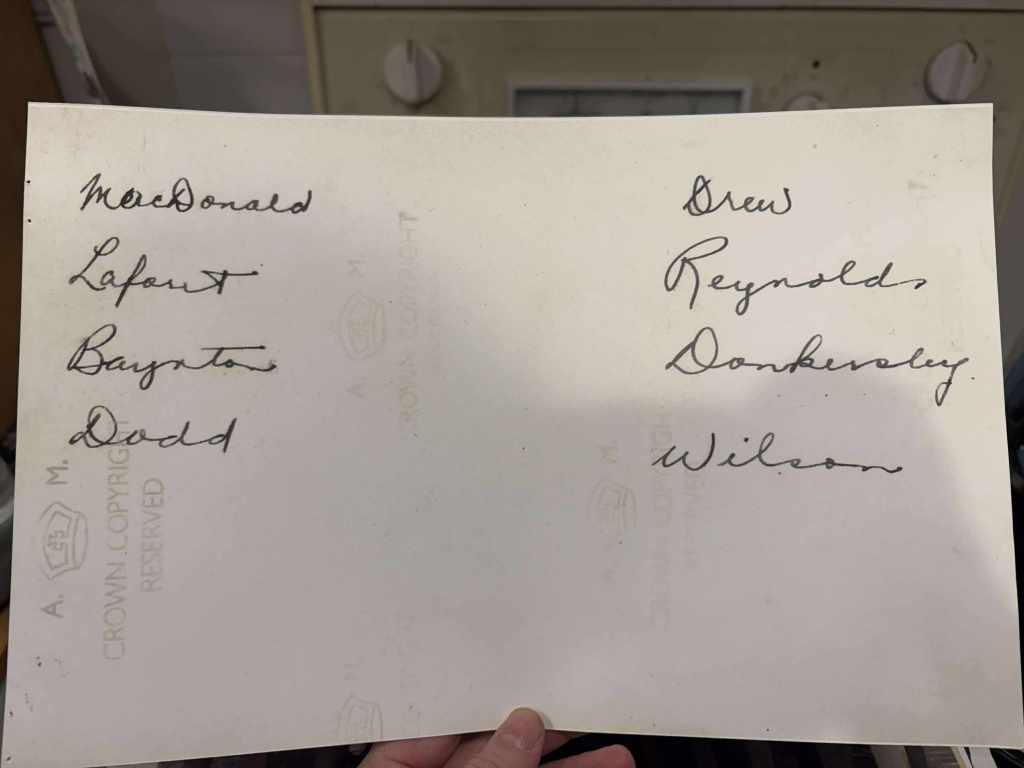
Reverse side of funeral photo. Photo: Courtesy of Rhys Nye.

In addition to the above funeral photo, we received this sharper version of a group photo, believed to be taken at No. 7 OTU in Limavady, Northern Ireland, on either July 18 or 23, 1942. We can now confirm the identities of all the men:
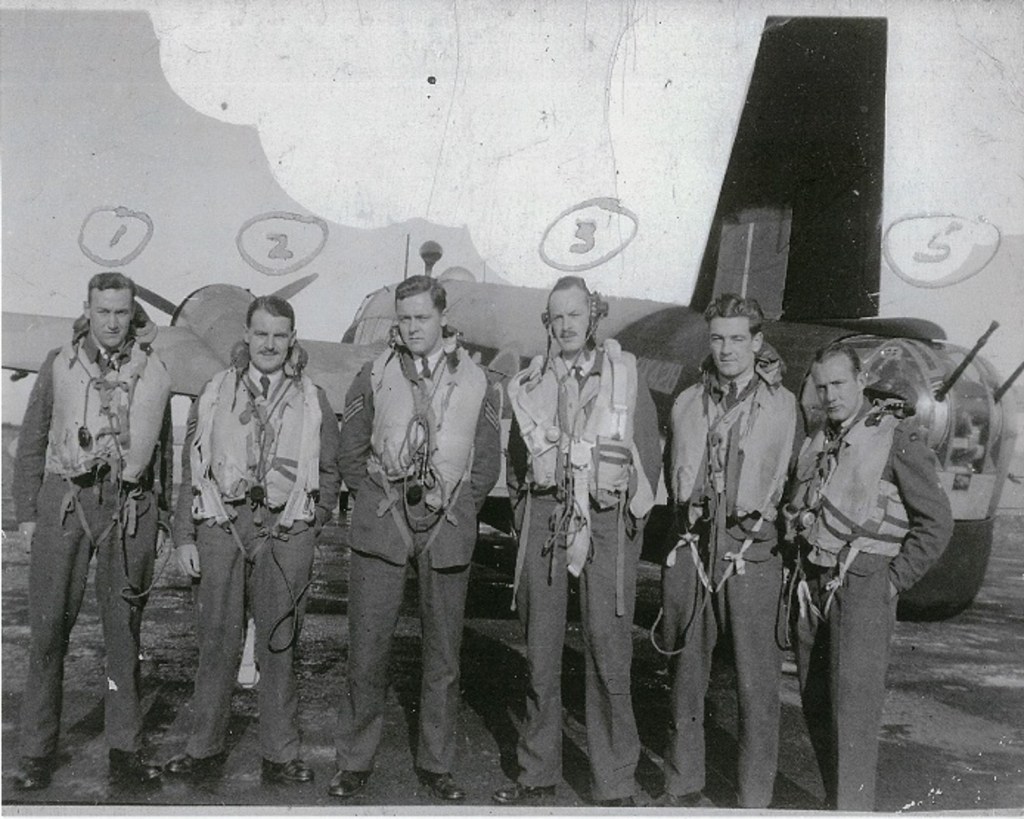
Group photo taken at No. 7 OTU in Limavady, Northern Ireland, on either July 18 or 23, 1942. Photo: Courtesy of Rhys Nye.

Left to right:

Harry Gleason had also labelled the back of the original photo, now in the Malta Aviation Museum’s collection. Photo: Courtesy of Rhys Nye.
  • (1) Sgt. Leonard John “Bus” Laforet – 632 Hall Ave., Windsor, Ontario: Died in 1992 (Source: daughter Laura Labute)
  • (2) Sgt. “Tommy” Tomlinson (first name unknown) – England
  • Not numbered: P/O Lawrence Harry Gleason – Canora, Saskatchewan: Killed in Wellington HX726 crash at Luqa, Malta, February 13, 1943
  • (3) P/O Maurice “Kemp” McAllister Kempton – Moose Jaw, Saskatchewan: Killed in Wellington HX726 crash at Luqa, Malta, February 13, 1943
  • (4) Sgt. Wendell “Del” Drew – Radisson, Saskatchewan: Lost on Lancaster JB707 over North Sea on July 29, 1944
  • (5) Sgt. Donald “Corny” Munroe – 835 Dawson Rd., Windsor, Ontario: Died in 2013 (Source: obituary)

The Wellington plane in the photo of the crew is HX428. An online search seems to indicate that it failed to return from a training exercise on October 28, 1942, with another entire crew being lost.

Thanks to Cate and Leonard Laforet’s daughter, Laura Labute, we also received this photo we had never seen before, of Leonard and Del standing together, probably sometime between June 1942 and February 1943:
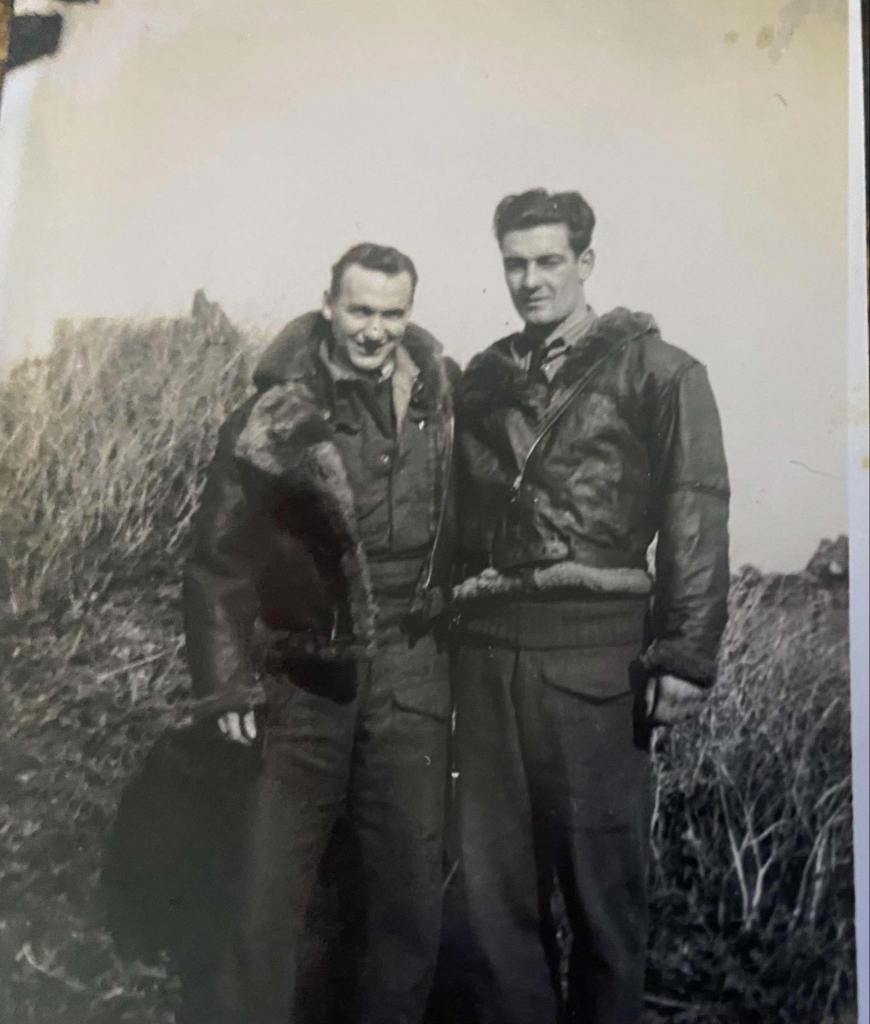
Leonard Laforet and Wendell Drew. Photo: Courtesy of Laura Labute (Laforet’s daughter).

We would also like to share this photo that appeared in Following the Echoes, for which we are now able to provide further identifications. It is from No. 7 (Coastal) OTU in Limavady, Northern Ireland, on June 9, 1942, or shortly thereafter:

No. 7 (Coastal) OTU in Limavady, Northern Ireland. Photo: Courtesy of Gary Noacks.

Wendell Drew is in the back row, sixth from left. Harry Gleason is in the centre row, second from left. Leonard Laforet is in the centre row, first from left. “Tommy” Tomlinson is in the centre row, third from left. Donald Munroe is in the centre row, last on the right.

Other names remain uncertain, but were labelled as follows:

Back row, left to right: McDougall, Yorke, Courahcane [sic?], Lepalme [sic?], McArthur, Wendell Drew, Drew, Belanger, Duffy, Dunbar, Jamisson [sic?], Dallaire, Louden.

Centre row, left to right: [Leonard] Laforet, [Harry] Gleason, Tomilson [Tomlinson], Grenwold, Kirwin, Harris, Britten, Smith, Adamson, Geddes, [Donald] Munroe.

Front row, left to right: Campbell, Abraham, Lyon, Radford, McLeod, Cook, Mahoney, Brown, Bell, Reynolds.

Note: There are two Drews standing next to each other. The man beside Wendell Drew is also named Drew, but we don’t know his first name. A relative of Wendell Drew recalls an airman of the same last name attending the funerals of Mr. and Mrs. Drew, who passed away within months of each other in 1966. This airman was from Edmonton and a friend of Wendell’s from the war. Maybe someone out there can help us with this mystery?
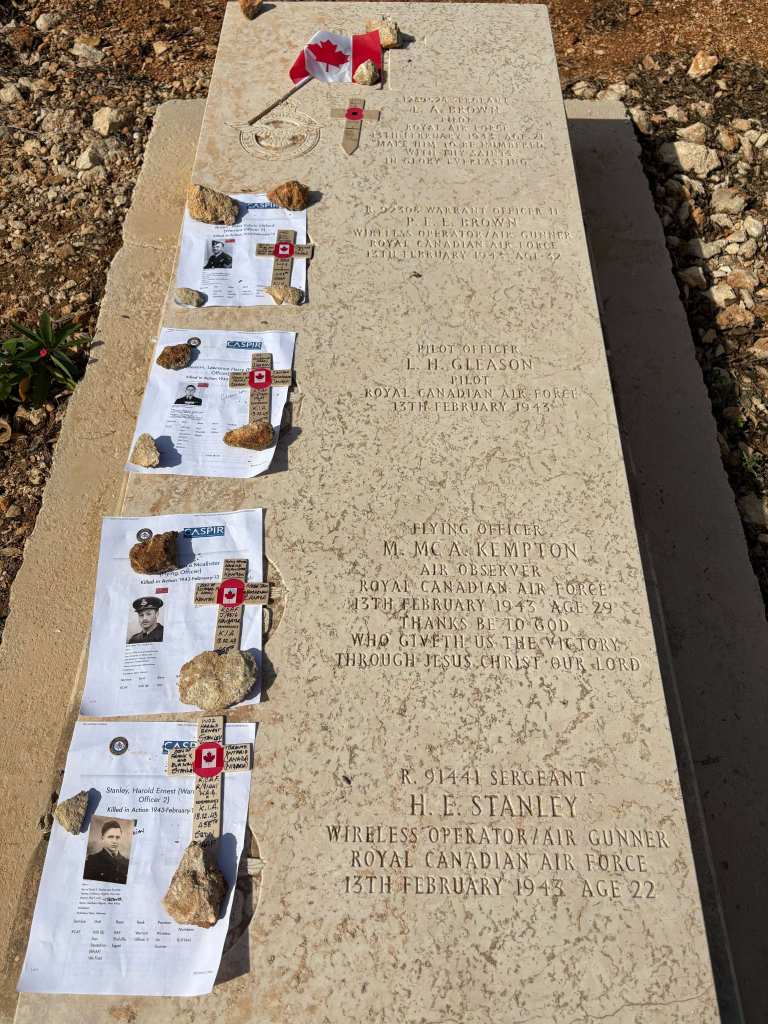
Gravesite commemoration of the Wellington HX726 crew at Capuccini Cemetery, Malta, October 2025. Photo: Courtesy of Cate Wagstaffe.

The Job to Be Done: A Review with a Special Connection

Author Clint L. Coffey. Photo courtesy of Clint Coffey.

Recently, my brother and co-author, Lance Fox, did an internet search related to our book, Following the Echoes, to see whether any new relevant documents had come to light.

In his search, Lance was excited to discover a blog post by Clint L. Coffey, who, as it turns out, is a fellow Canadian and a fellow FriesenPress author of the same year (2023). Also, his book, The Job to Be Done: A Son’s Journey Into the Story of a WW2 Bomber Command Aircrew, is about a Bomber Command crew of personal significance (the pilot, Flying Officer Jesse Coffey, was Clint’s father).

But this was not all that connected us to Clint. It was while searching for any new mentions of names or topics related to Following the Echoes—specifically Lancaster JB707, in which Wendell “Del” Drew and his crew, piloted by Flying Officer Elwood Townsend, perished in 1944—that Lance found Clint’s post.

In the post, Clint mentions that the Coffey crew flew JB707 on several operations in July of 1944, just days before it would disappear with the Townsend crew on board; JB707 and the Townsend crew are also mentioned by name in his book. There are two Lancasters that the Coffey and Townsend crews each flew at least once, ND616 and JB707, the latter of which the Coffey flew on seven sorties from July 6–19, 1944.

Almost certainly, Clint’s dad and the Coffey crew would have known Del and the Townsend crew from their time in 405 Squadron in June and July of 1944. Two members of the Coffey crew were also from rural Saskatchewan and likely had much in common with Del. While the Townsend crew was lost, the Coffey crew, against overwhelmingly negative odds and despite many close shaves, survived.

In The Job to Be Done, using his dad’s logbook as a starting point, Clint takes the reader through the journey of a bomber crew right from training until the end of the war and beyond, offering a deeper understanding of what they experienced. One cannot read this book without acquiring a profound appreciation for the unbelievably steep learning curve that these (often very) young men of Bomber Command, many with only the most basic of education, had to overcome, both individually and as a team. By the end of the war, their success was evident—the scars they bore as a result less so, particularly the psychological ones.

It is those scars, from dozens of physically gruelling and psychologically brutal operational flights, that come to light as Clint pieces together the story of the Coffey crew also as individuals. Having managed to track down relatives of each crew member, and even the last living member (by then in his nineties), Clint brings the story full circle, giving us a glimpse into their post-war lives, their ultimate fates both heartening and heartbreaking.

The Job to Be Done also touches on many other fascinating stories that could easily take readers down a rabbit hole. One of these, the mysterious story of Pilot Officer Ross Bell Nairn, has really piqued my interest and deserves a post of its own (stay tuned).

It took Clint around eight years to research and write The Job to Be Done. Reading it, I was amazed that one person—particularly one for whom historical research is not his day job—managed to write such a detailed book in just eight years. His work is a prime example of the value and importance of so-called amateur historians, with the contribution of personal stories and accounts that would otherwise be lost forever to the historical record of the nation and the world. Clint passionately and eloquently expresses the significance and sacrifice of Bomber Command and our “bomber boys,” putting into perspective the price that was paid to buy our freedom.

Finally, in the book, Clint tells of how, during a visit to his parents’ home in the mid-1980s, he came across a sheet of paper in his dad’s handwriting. Words crossed out and rewritten, the quote had evidently undergone some tweaking to get it just right. Clint writes:

I thought about asking him about the quote, but it seemed almost an invasion of his privacy, as obviously he had not meant for anyone else to read it. I settled on writing out my own copy of his words and saving them, which in retrospect was, I suppose, an even worse invasion of privacy! Be that as it may, I am very glad I did, as the piece of paper with the quote was gone when I went through his books after he died.

Little did either of them know at the time, in that short verse that Jesse Coffey penned was the title of the poignant tribute that his son would write decades later:

Mine was not a war of bugle calls and roaring engines and magnificent defiance in the clamour of battle;

Mine was a war of patience and endurance and stability;

of cunning and craft and stealth;

Of attention to details and giving my best to learn all there was to learn about the job to be done.

This book review is dedicated to the brave and heroic members of the Coffey Crew, all of whom were willing to pay the supreme sacrifice, at any time, for years on end, if that’s what it took to do the job to be done:

  • Flying Officer Jesse Ray Coffey (pilot): Czar, Alberta
  • Flying Officer Raymond “Ted” Rutherglen (wireless operator/air gunner): Nelson, British Columbia
  • Flying Officer Digby “Jimmy” Willoughby (flight engineer): Kingston, Jamaica
  • Pilot Officer Ken Hart (mid-upper gunner): London, Ontario
  • Pilot Officer Malcolm Dingwall (bomb aimer): Shellbrook, Saskatchewan
  • Flying Officer Robert Bayne (navigator): Ottawa, Ontario
  • Flying Officer Robert McWhirter (rear gunner): Prince Albert, Saskatchewan

The Job to Be Done by Clint L. Coffey is available in hardcover, paperback, and eBook through major booksellers such as Chapters-Indigo and Amazon.