RELATED POSTS:
- Following the Echoes: The Others
- Following the Echoes: Into the Abyss
- Following the Echoes: Hold On to Those Old Letters
In the description for Following the Echoes, I wrote that the book “reflects on the ripple effect that the pulling of literal and metaphorical triggers can have on our lives.”
This past summer, Lance and I were reminded of the extent of that ripple effect from the pulling of triggers—and I don’t mean of the metaphorical kind.
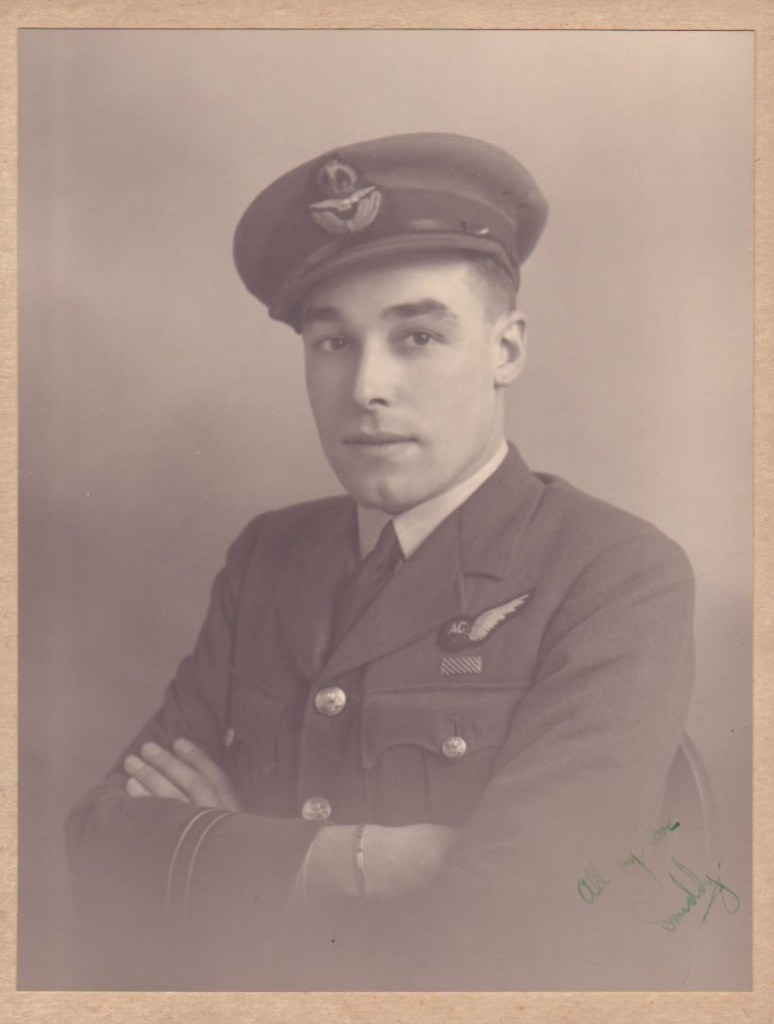
On July 30, Lance happened to notice a memorial post in an RAF Bomber Command Facebook group by a woman named Karen Quaile, who was remembering her grandfather, F/L Bertram Leonard Smith, aka “Smiddy,” a wireless operator/air gunner who disappeared on Lancaster KB759 of RCAF 428 Ghost Squadron on the night of July 28/29, 1944, on a bombing raid to Hamburg—the same night and the same raid from which Wendell “Del” Drew failed to return on Lancaster JB707.
Following the Echoes is the first book to examine in depth the fate of Lancaster JB707, piecing together the events of the last sortie, describing what the crew’s final moments could have been like.
And this is where JB707 is so closely linked to KB759. While five Lancasters failed to return from the raid that night, the fate of three remained a mystery: JB707 (of 405 Squadron), LL725 (of 408 Squadron), and KB759 (of 428 Squadron).
KB759 had taken off from RAF Middleton St. George in County Durham but disappeared without a trace. There is strong evidence that JB707 and KB759 met a very similar end, likely perishing within minutes of each other over the North Sea somewhere near Helgoland.
Lance and I were able to connect with Karen and her father, Michael Smith, who both reside in Tasmania, Australia, and who were very grateful to learn of our research, as it was so relevant to their own story.
When F/L Bertram Smith was lost that night over the North Sea, his wife, Bertha (née Gardner), was pregnant with their child; Bert knew he was going to be a father, but he never got to meet his child, Michael, born three months later on November 1, 1944.
Bert would not be legally declared dead for another seven years. On August 1, 1951, two days after the seventh anniversary of Bert’s death, Bertha married widower Frederick Maitland, whose first wife, Doris Maitland (née Crittall), had died of tuberculosis in 1949. Frederick thus became Michael’s dad.
While it was his father, Bert, who passed his genes down to him, it was his dad, Frederick, who helped shape his character by example, says Michael: Frederick Maitland “truly understood the meaning of the word ‘family.’”
Michael credits his dad for encouraging him to always remember his origins and his father. This made it easier for him when he started to do his family research in the 1980s, after his mother gave him all his father’s personal effects, including medals, photos, and his flying logbook from the war.
In 2021, Michael scanned his father’s logbook and turned it into a limited-edition book, Smiddy, for family members; the RAF Museum in London also has a copy, and the Bomber Command Museum in Nanton, Alberta, has some scanned pages of Smiddy’s logbook.
“My intention to write his life story has been hampered by the lack of specific details of his death so necessary for closure,” Michael wrote, thanking us for sharing the details of our research, which, “although emotionally difficult to read, is the last piece in the jigsaw puzzle.”
I asked Michael how his family ultimately ended up in Australia. After the family applied for assisted passage but was rejected in the 1960s, Michael paid for passage himself on a migrant ship in the mid-1960s. A fellow worker had a brother living in Tasmania, and so he decided to go there. In the late 1960s, after a harsh winter back in England destroyed their lettuce crop, Michael’s family followed.
Karen adds: “As with most families after WW2, a new beginning heralded a move to the other side of the world, Australia in our case, but we never forget where we come from.”
Michael has given his children and grandchildren a replica set of Bert’s medals and a copy of Smiddy in memory of his service and ultimate sacrifice. And now Lance and I have been honoured to receive our own copy of Smiddy, a reminder of all those whose lives were completely changed by the events of that fateful night in July 1944, even many decades later, and around the globe.
I conclude with Michael’s words to me and Lance:
It has been Karen’s interest in adding to my research of her grandfather’s death that has connected our families. Although we are not genetically bonded, we are nonetheless linked, not only as part of the RAF and RCAF aircrew family, but specifically by the death of two grandfathers [Ed. note: even though he is not our actual grandfather, Del has become an honoured grandfatherlike figure to our family] that died on the same night operation within minutes of each other.
The fickle finger of fate moves in mysterious ways.
United in grief,
Michael
Crew Members of Lancaster KB759 NA-K’s Final Sortie:
2nd Pilot: F/O Reginald Parsons, 20, Timmins, Ontario, and Carrying Place, Ontario, Canada
Pilot: P/O Thomas Eldon Magill, 26, Garson, Ontario, Canada
Flight Engineer: P/O Arthur Ernest Attewell, 22, Toronto, Ontario, Canada
Navigator: P/O James Arthur Urquhart, 20, Montreal, Quebec, Canada
Air Bomber: P/O Thomas Graham Murdoch, 21, Lindsay, Ontario, Canada
Wireless Operator/Air Gunner: F/L Bertram Leonard Smith, 26, Barking, Essex, England
Mid-Upper Gunner: P/O Hugh Alexander Adams, 23, Springside, Saskatchewan, Canada
Rear Gunner: P/O Francis Bruce Thaine, 19, Northallerton, Yorkshire, England (Born in England but migrated to Canada in 1938 and lived with a relative who had migrated years earlier.)
GHOST SQUADRON

by Michael Smith

Ghosts of Squadron four two eight
Nightly Ops seal their fate
Tired crews of different ages
Fill the Station’s many pages
Broken aircraft coming down
Over sea, city and country town
Fresh faces take off into the night
Trained to continue the cruel fight
Ground crews toil on battered planes
Fixing everything and driving cranes
WAAFS drive aircrew to and fro
Gathering to watch the last plane go
Officer stands in morning’s misty light
How many missing from each Flight

